An AI agent is good at the first reply. It is awake at three in the morning, it has read every page of your site, and it answers in seconds. The hard part is not the first reply. The hard part is knowing when the AI should stop and a person should start.
ATON Desk is coming soon and is not open to customers yet. This article explains how we think about hand-over, and how the product is built to handle it.
Say it is an AI, before anything else
The first thing the AI agent does in ATON Desk is say that it is an AI. Not in small print, not after three messages, but in its first answer.
This matters for a plain reason. People talk differently to a machine than to a person. If they think they are talking to a person and find out later that they were not, they feel tricked, and the rest of the conversation is poisoned. If they know from the start, they can decide how much to trust the answer and whether to ask for a person.
It also keeps your team honest. Nobody on your side has to pretend. The AI is a tool that answers first, and everyone in the chat knows that.
Offer a person after the first answer
Many chat tools make the customer fight through a menu or type a magic word to reach a human. We think that is backwards.
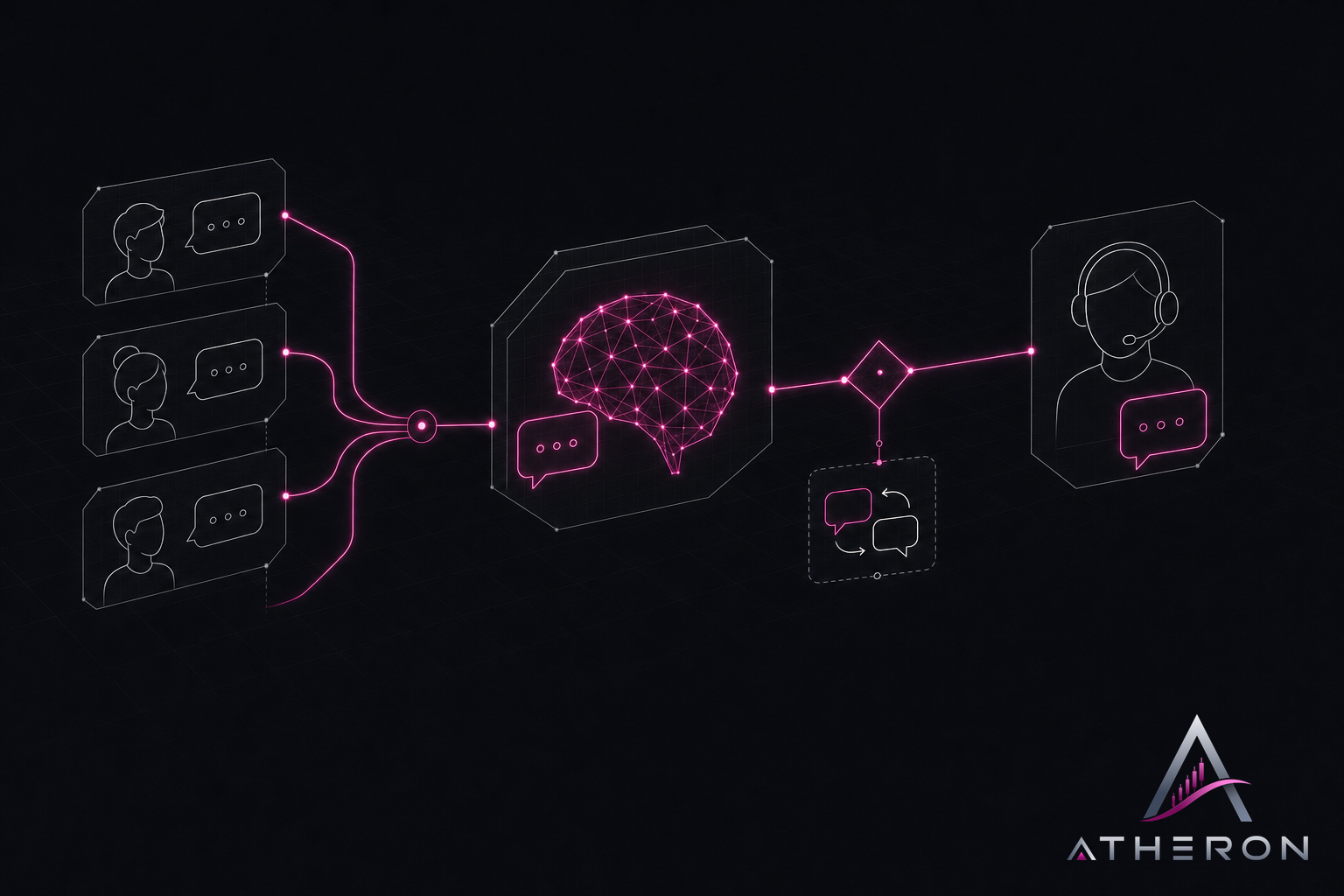
In ATON Desk, the AI offers a person right after its first answer. The customer reads the reply. If it solved the problem, they are done. If it did not, the way to a person is already in front of them. They do not have to guess how to escape the bot.
This is the simplest hand-over rule there is: let the customer choose, and make the choice visible early.
Hand-over rules that hold up
Beyond the customer asking, there are moments where a chat should go to a person whether or not anyone asked. These are the rules we build around.
- The customer asks for a person. This one is absolute. Any time, any wording, the answer is yes.
- The AI does not have the answer. The agent is trained on your website, your files and the answers you give it. When a question falls outside that, the right move is to say so and offer a person, not to guess.
- The question is about money, an account or a complaint. A refund, a billing dispute, a cancelled order, an angry message. These need judgement and sometimes authority the AI does not have.
- The customer repeats the question. If someone asks the same thing twice, the first answer did not land. A second AI answer rarely does better.
- Something is wrong on your side. An outage, a broken checkout, a shipping delay. The AI may not know yet, and a person can say what is actually happening.
What the operator sees
A hand-over is only good if the person taking over does not start from zero. Nobody wants to read a wall of chat history while the customer waits.
In ATON Desk, an operator takes the chat in one click and gets a short summary. What the customer asked, what the AI already said, and where it got stuck. The operator reads it in a few seconds and picks up the conversation from there, instead of asking the customer to repeat everything.
That summary is the difference between a hand-over and a restart. The customer should feel that one conversation continued, not that a new one began.
What happens to the questions the AI could not answer
Every hand-over is a signal. If the AI did not know something, there is a gap in what it was trained on.
ATON Desk turns unanswered questions into draft articles for you to approve. You read the draft, fix it or reject it, and the next time someone asks, the AI has the answer. Over time the hand-overs that happen because of missing knowledge get rarer, and the ones that remain are the ones that genuinely need a person.
Honest limits
An AI agent will not get every hand-over right. It will sometimes answer when it should have passed, and sometimes pass when it could have answered. The rules above reduce that, and the draft articles close gaps over time, but a person should still read a sample of chats and adjust.
We run Atheron's own support on ATON Desk, so these rules are ones we live with ourselves. When the product opens, you will be able to try it with a free plan and a trial that needs no card. Until then, you can join the waitlist and we will tell you when it is ready.